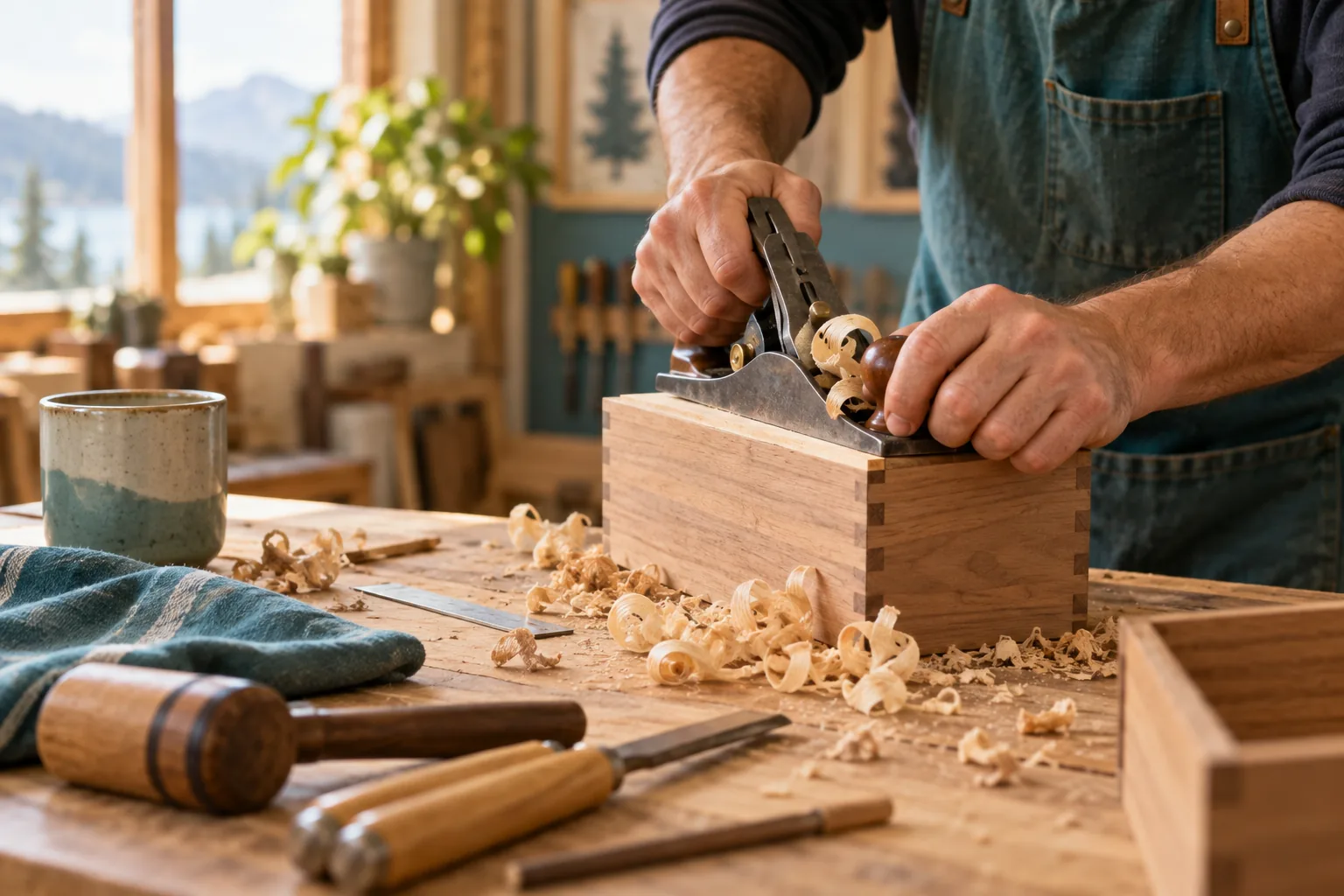
Pick your woodworking class based on the specific skill you want to walk away with, how much hands-on supervision you actually need, and whether the location is easy enough to visit repeatedly. A project that looks great in a photo might not be the ideal starting point. A class focused on box-making can teach you about accurate joinery and marking; a quick turning lesson focuses on lathe techniques; and a makerspace orientation might be your gateway to using tools independently.
Start with the outcome
People generally book classes for three main reasons. You might want a finished product, a basic understanding of tool safety and fundamentals, or a way to gain access to a workshop to build your own things. Deciding which of these is your priority is the best place to start.
A project-based workshop follows a set sequence and gives you a finished item to take home. This is a good choice if you want a contained, one-off experience. A fundamentals course that spans several sessions gives you more time to repeat tasks, fix mistakes, and practice finishing. An orientation focuses on using machines safely and might be the way to unlock shop access later, though it might not offer the same level of guided making. If a class tries to do all three, ask exactly how much time is spent on each.
Woodturning is a specific discipline that requires its own decision. It involves shaping wood on a lathe, which feels quite different from building furniture with flat boards and joinery. Ed's Woodturning in Langley provides one-to-one instruction, whereas other schools might just include turning as one part of a wider curriculum. Choose it because you are interested in that specific process, not just because the initial project is small.
Match the teaching format to how you learn
Find out how many people are in the class and how demonstrations are structured around practice time. While small groups can mean more feedback, the actual workflow of the instructor, the equipment, and the project itself will dictate how much individual help you get. You should ask if every student is making the exact same item, if you can redo a mistake during the session, and if you will receive written notes or measurements.
Be honest about the pace. A short taster session can show you if you actually like being in a shop, while a weekly course allows techniques to actually sink in. Driving from Burnaby to Langley for one lesson might be fine, but you should consider if you can handle that same trip for ten sessions in a row. The Urban Woodworker has courses at Lower Lonsdale, Yaletown and Clayton, but keep in mind that their offerings change depending on the location. Check the actual schedule and your travel route, not just the closest location on a map.
Understand what the fee and course include
You need to confirm if the price covers timber, hardware, consumables, safety gear, and finishes. Ask if the finished object will be completely dry and ready to take home, and find out if you can make up a session if you miss one. A cheap headline price can end up being poor value if you have to buy your own materials or pay for extra shop time to finish the project. On the other hand, a long course might teach you many techniques that you don't actually need yet.
If your goal is to keep making things after the class ends, ask about the next steps. MakerLabs currently requires you to complete relevant orientation and safety training before you can access tools, and they offer memberships or drop-in options separately. Edge City offers structured classes and mentions that qualifying students can move on to drop-in work or coaching. You shouldn't assume a "workshop" label includes these options; get the specific sequence in writing.
Compare the strongest local fit
- Edge City Woodworking School runs small group classes in East Vancouver that focus on both modern and traditional furniture-making. Their guidance suggests different starting points for beginners rather than making every project the same.
- The Urban Woodworker offers adult classes at the Clayton Community Centre, Yaletown/Roundhouse, and Lower Lonsdale, so location is a major factor in your choice.
- MakerLabs Vancouver is a good option if you are deciding between a single project workshop and a longer path into a facility with multiple tools.
- Ed's Woodturning is the way to go if you want specialized, private instruction in turning.
A final decision test
Before you pay, ask the instructor to explain what a total beginner will be doing during the first hour, what tools will be used, and what the final result will be. It is also worth asking what a successful next step looks like after the class is done. A clear response is more helpful than a polished photo in a gallery. Choose the course where the instruction, the work, and the ability to keep going actually fit your life, rather than just picking the one with the prettiest finished sample.