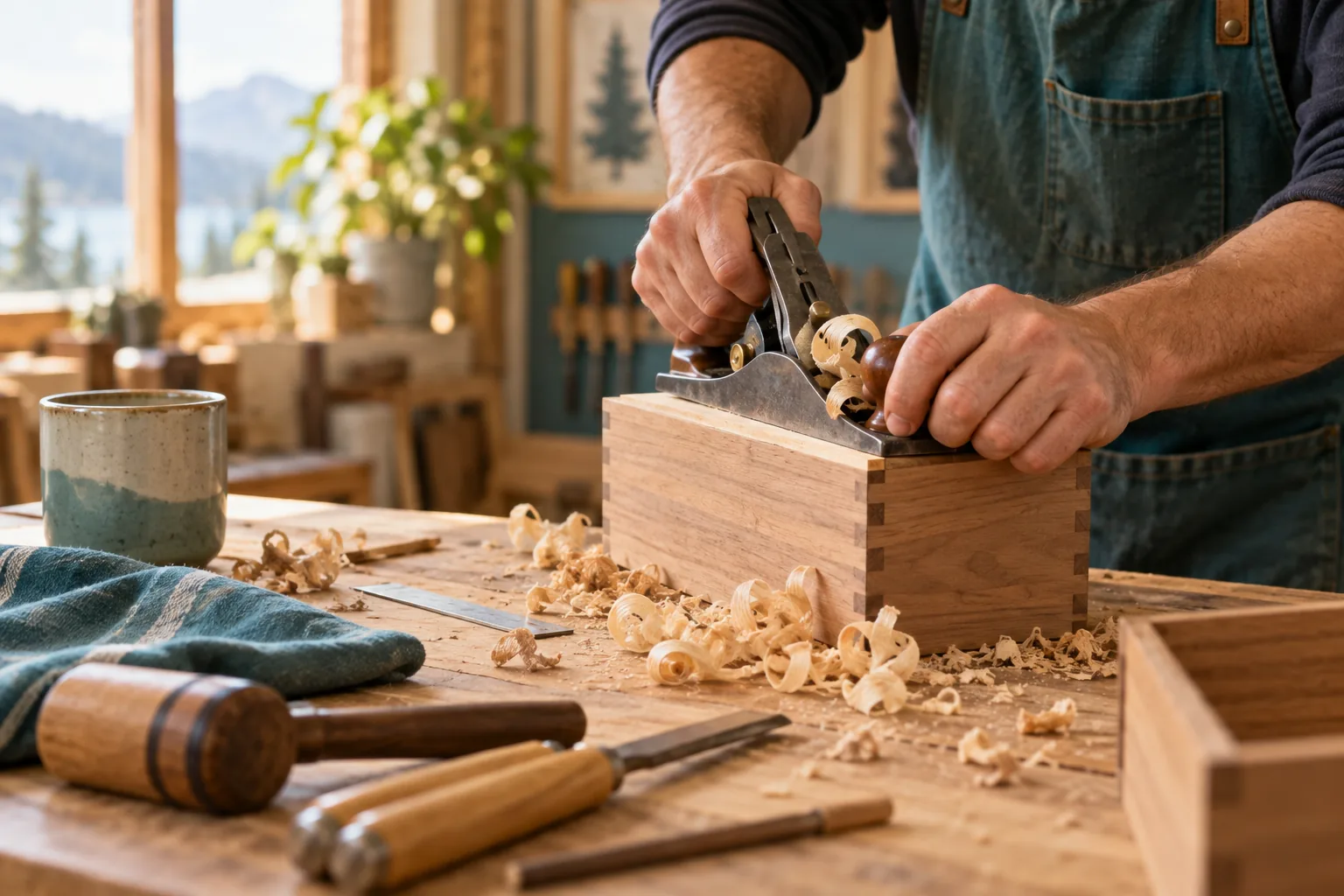
Your first woodworking class will go much smoother if you prepare for the actual shop, the specific project, and the commute rather than just buying a bag of tools before day one. Most beginner courses are designed around the equipment the provider already has. The most useful work happens before you ever step into the shop: confirm what your booking covers, learn the clothing rules, and understand exactly what you will be carrying home at the end.
Before you book
Read the full course description and check the teaching location. The Urban Woodworker, for example, teaches at Lower Lonsdale, the Roundhouse in Yaletown, and Clayton Community Centre, and they note that courses differ depending on the venue. A class title alone won't tell you the venue or the format.
Ask these questions:
- Is the course suitable for someone with no tool experience?
- Is it a single session, a series, or an orientation for later shop access?
- Are timber, hardware, finishes, and consumables included in the price?
- Will the project be finished by the last class, or will finishing happen at home?
- What is the minimum age, and does a younger participant need an accompanying adult?
- What is the policy if the provider postpones a class or you miss a meeting?
If your goal is to work independently later, ask whether the course grants any continuing access. MakerLabs distinguishes project workshops from tool-area safety and orientation classes; membership or drop-in use is handled separately. Getting a finished cutting board and getting permission to return to a shared wood shop are two very different outcomes.
Dress for a working shop
Follow the provider’s instructions above all else. Until you receive them, plan on wearing closed-toe footwear, fitted clothes, and keeping long hair tied back. Avoid loose sleeves, dangling jewellery, or anything else that could catch in a rotating tool. Ask whether eye and hearing protection are provided and if you are allowed to bring your own properly fitting versions.
Do not bring gloves for machine work unless the instructor specifically asks for them for a particular task. If you use prescription glasses, hearing aids, a mobility device, or any other aid that affects protective equipment, mention that before class so the instructor can explain the setup. Wood dust, finishes, and adhesives can also be an issue for people with sensitivities; ask what materials the project uses instead of trying to guess from a photo.
Pack lightly and label the essentials
A pencil, notebook, and water bottle are usually useful, but confirm what is actually allowed in the work area. Bring any safety gear the provider requires, medication you normally carry, and a phone with the venue directions saved. Do not show up with your own chisels, lumber, or finish unless the course specifically asks for them. Unrequested materials often end up being unsuitable for the tools or the lesson plan.
Plan your trip home. A small box might fit in a backpack, but a stool, a wet finish, or a partly assembled object might not. Ask for the finished dimensions and whether the piece can travel immediately. If you are coming from Burnaby, Surrey, or North Vancouver, that answer will determine whether transit is a sensible option or if you need a vehicle and some padding.
On the day
Arrive early enough to find the unit, sign any waivers, and hear the opening safety briefing. Industrial buildings can be harder to navigate than a street-front studio. Do not operate a tool you have not been cleared to use, even if you have used a similar model somewhere else. Tell the instructor if you cannot see a demonstration, hear a direction, or maintain a safe grip.
Photographing setup steps can be helpful for your notes later, but ask before you start recording people or instruction. Mark your components if several students are making the exact same object. Before leaving, confirm whether the surface is fully cured, what maintenance the piece needs, and whether you should take any offcuts or leftover finish home with you.
Compare three local formats
- MakerLabs Vancouver offers orientations and project workshops within a multi-tool makerspace at East Cordova Street.
- Edge City Woodworking School teaches small-group furniture and hand-tool skills in East Vancouver and publishes course-specific beginner guidance.
- The Urban Woodworker runs adult courses across three Metro Vancouver locations, with different offerings at each.
Save your booking email and recheck it the day before class. The exact address, start time, clothing rules, and supplied materials are much more important than any generic first-timer packing list.