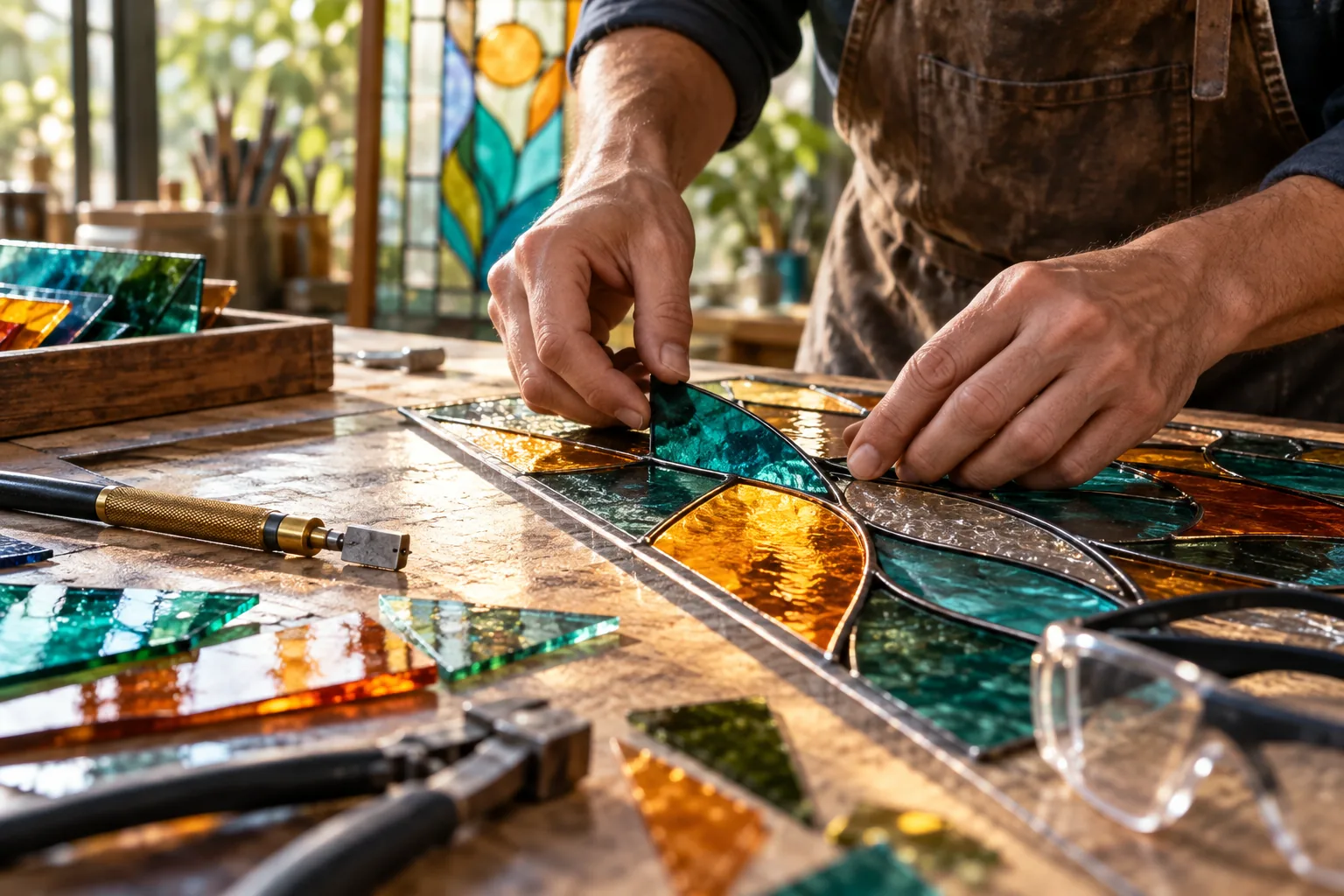
Don't just look for "glass" classes; look for the specific method. Stained glass involves putting cut pieces together into an object, whereas fused glass uses compatible pieces that get fired in a kiln. Glassblowing and flameworking use heat to shape molten glass with entirely different tools. If you are a beginner in Burnaby or Richmond, ask the instructor exactly what you will be cutting, assembling, and bringing home.
Stained glass has several linked stages
In a typical copper-foil project, you start with a pattern and your choice of glass. Then you move through cutting, shaping or grinding, wrapping the edges in foil, and finally soldering the pieces. Depending on the course, an instructor might walk you through every single step or might have already prepared some parts for you.
You should ask which steps you will be doing yourself and if the project will be finished in a single session. A small suncatcher might be a better way to learn the full sequence than a large panel that takes longer than the class allows.
Cutting and grinding require control
Scoring a piece of glass is different from sawing through it. You need an instructor to show you how to manage pressure, the right direction to break, and how to handle sharp edges safely. While grinders are used to shape pieces so they fit together, you still need eye protection and careful hand placement while using them.
Check to see what protective gear the studio provides and how they manage glass fragments. Make sure to wear closed-toe shoes and clothing that fits the studio's specific rules. Before you spend money on your own cutters, pliers, or a general kit, make sure the provider confirms that your tools will work with their specific method.
Joining methods are not interchangeable
Copper foil is wrapped around every edge before you solder it. Alternatively, lead came is used to hold glass inside channels, which is a different way to build panels. If a class description specifies a method, ask why it was chosen for that project and what the specific cleanup or handling requirements are.
Soldering involves heat, fumes, and potential lead exposure in many traditional studios. You must follow the studio's rules for ventilation, handwashing, and clothing. If you are pregnant or have other health concerns, disclose this and ask if the class is appropriate for you; don't just assume a "beginner" label means it is safe for everyone.
Fusing follows another workflow
If you are taking a fused-glass class, you might cut and arrange your pieces, but you won't be soldering them. The staff will put your design in a kiln after class, which means you will likely come back later to pick up the finished object. Ask about glass compatibility, the firing schedule, when you can pick it up, and the risk of the piece breaking.
Fusing can be a quick way to try out glass design, but keep in mind it won't teach you how to assemble stained glass. Choose it because you want to work with kiln-formed glass, not because you think it is a substitute for a stained-glass class.
Plan for the finished object
Find out if the class price covers materials, the pattern, and the hardware needed to hang the piece. You also need to know how you will physically carry the finished work home. If the studio has to keep the piece for firing or extra work, ask how they will notify you, how long they will store it, and if you can send someone else to pick it up.
If you have accessibility needs, talk to the instructor about things like standing, hand strength, visual requirements, the height of the workstation, or the ability to take breaks. A provider needs to look at their actual room and equipment to give you a real answer.
Compare current Vancouver and North Shore options
Awesome Sauce Designs at MakerLabs in Vancouver currently teaches beginner copper-foil stained glass, which covers cutting, shaping, foiling, and soldering. They also offer separate workshops for fused glass. Their official info includes health and safety guidance for each method.
Bella Ceramica Studio in West Vancouver focuses on glass fusing. This requires later kiln firing; it isn't a class for building stained-glass pieces. Terminal City Glass in Vancouver teaches hot-glass methods like glassblowing, flameworking, or beadmaking, which are different paths entirely.
Start with one complete method
Pick a project that lets you experience the entire process from start to finish safely. Take note of the glass type, the tools used, and whether the pieces are joined or fired. You will learn much more about which process you actually like by finishing one small stained-glass or fused-glass project than you will by simply picking a class because the finished photo looks nice.