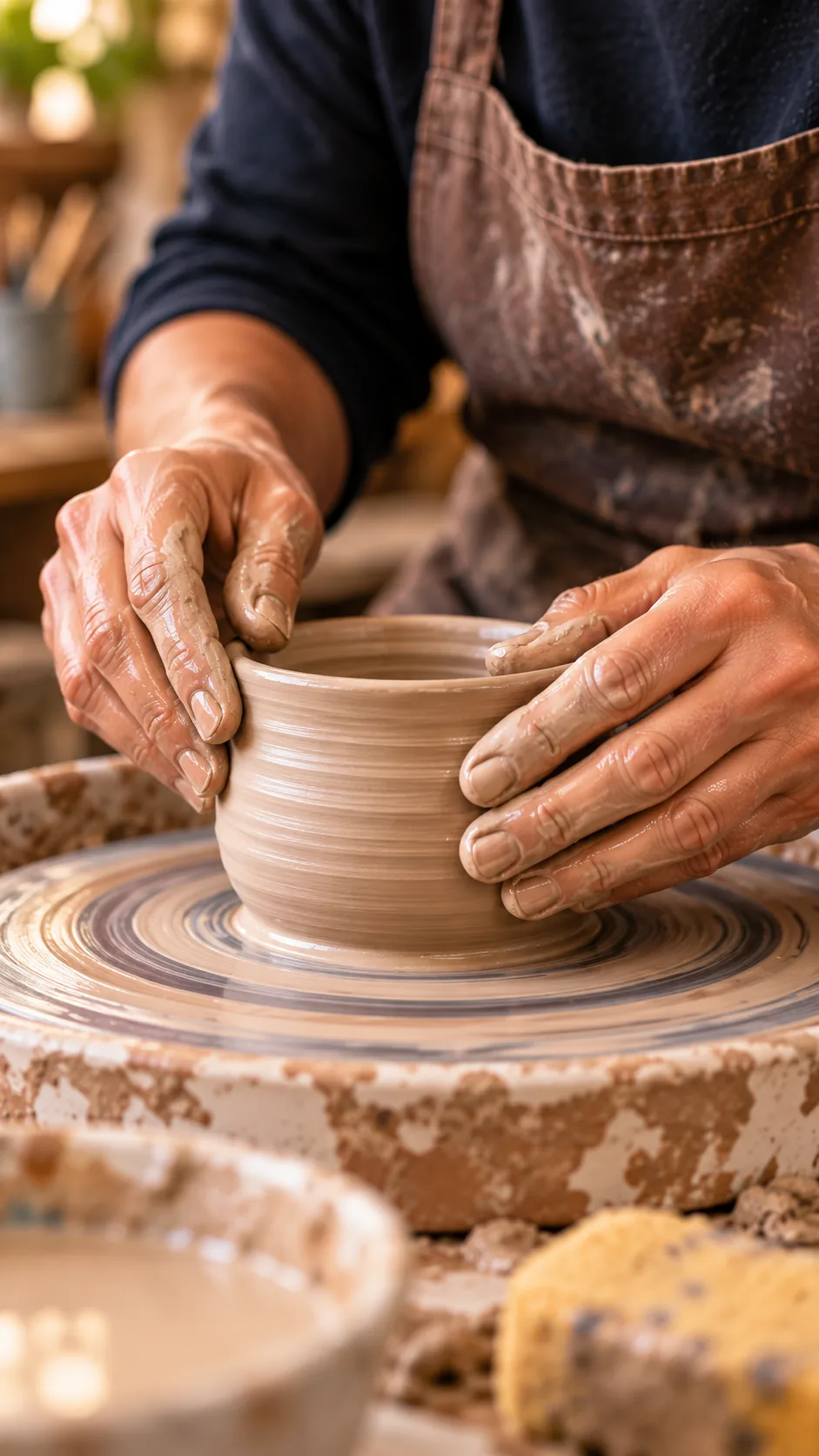
The best pottery class isn't necessarily the longest course or the studio closest to your house. The right choice is the one where the teaching method, depth of instruction, travel time, and post-class process all align with your actual goals. Before you book, decide if success for you means enjoying a single evening, taking home a specific object, or building a skill you can practice repeatedly.
Choose the outcome before the studio
Pick pottery painting if you mainly want to decorate a ready-made form. Choose handbuilding if you want to create the form yourself at a table using pinching, coils, or slabs. Look at a wheel workshop if the attraction is trying the spinning process. Consider a multi-week course when you want repeated feedback and time to learn the stages beyond the first wet piece.
A one-off wheel session is a useful introduction, but it cannot offer the repetition of a course. A membership is different again; it is studio access intended for people who can work with more independence. Do not book access as a substitute for instruction unless the provider explicitly says teaching is included.
Match the teaching format to your goal
Ask how much of the session is spent on demonstration, guided practice, and independent work. Project-led workshops can be satisfying when you want a defined result. Technique-led classes may produce less predictable objects but teach skills that transfer to later work. For a course, ask whether it covers trimming and glazing as well as forming clay, and what happens if you miss a meeting.
Group size affects how much individual help you get. Rather than assuming smaller is always better, ask how instruction is shared and whether the teacher can support an absolute beginner. If you need an adapted setup, extra processing time, or a quieter position, discuss the specific class and room before booking.
Calculate the whole commitment
Compare what is included: clay, tools, glaze, firing, practice time, and the number or size of pieces you keep. Exact packages vary, so a lower advertised amount may cover less studio processing. Ask about taxes and optional purchases, but also count travel, parking or transit, and the eventual collection trip.
In the Lower Mainland, location matters differently for a workshop versus a course. Crossing the region once for a special project might be reasonable. Repeating that journey for six evenings, practice visits, and pickups can change the entire experience. Check the address attached to the selected class and consider the late-evening trip home.
Use local providers as different comparison points
Cafe au Clay Studios in Vancouver lists wheel and handbuilding instruction, workshops, private classes, drop-in painting, and membership. Its range makes it useful for comparing guided learning with independent studio access. Confirm the specific inclusions and availability for the format you choose.
Clayground Ceramics Studio in South Surrey distinguishes introductory workshops from longer wheel and handbuilding classes and memberships. Someone in Surrey may find that repeatable journey more practical than traveling into Vancouver, while a one-time visitor can compare the specific projects themselves.
Stablehands Pottery gives Fraser Valley learners an Abbotsford wheel option. Its official site says it is not currently offering handbuilding classes. Ask which current class contains the stage you want rather than assuming every advertised activity appears in every session.
Check what happens after making
Wet clay is only the beginning. Ask who trims, dries, glazes, and fires the work, how many pieces are kept, and whether you choose the glaze. Confirm the collection estimate and the final hold period. If you want a food-use object, ask the studio about the particular clay and glaze process rather than applying a general rule to all ceramics.
Kiln work carries uncertainty. Cracks, warping, and glaze variation can happen. A studio's policy for unsuccessful work is therefore a useful part of the comparison, especially if you are working on a gift or a milestone project.
Make the final choice with three tests
Choose the booking you can describe clearly in one sentence: what you will do, how you will be taught, and what happens to the piece afterward. Make sure its full cost and repeated travel fit your plans. Finally, make sure the studio has answered any age, access, or support questions that affect your participation.
If two choices still look equal, begin with a short guided workshop and use the experience to decide whether to pursue the wheel, handbuilding, or surface decoration. Browse the pottery providers and local area pages with that method in mind.